

How to Create a Daily Study Schedule – You Can Actually Stick To ?
For senior secondary students balancing school classes, self-study, and extracurricular activities, managing time often feels like an impossible puzzle. Facing long commerce syllabus—from Accountancy numerical to Business Studies case studies—many students build overly ambitious daily timetables.
You have likely created a schedule that looks like this: Wake up at 5:00 AM, study for 4 hours non-stop, attend school, study for another 5 hours, and sleep.
The problem? By Day 3, exhaustion sets in, tasks pile up, and the timetable ends up in the trash.
Creating a study schedule isn’t about fitting as many hours as possible into a single day; it’s about building a practical balance between school classes, self-study, and rest time without feeling overwhelmed. Drawing from over 25 years of teaching experience mentoring over 10,000 students, here is a step-by-step framework to design a routine you can actually stick to.
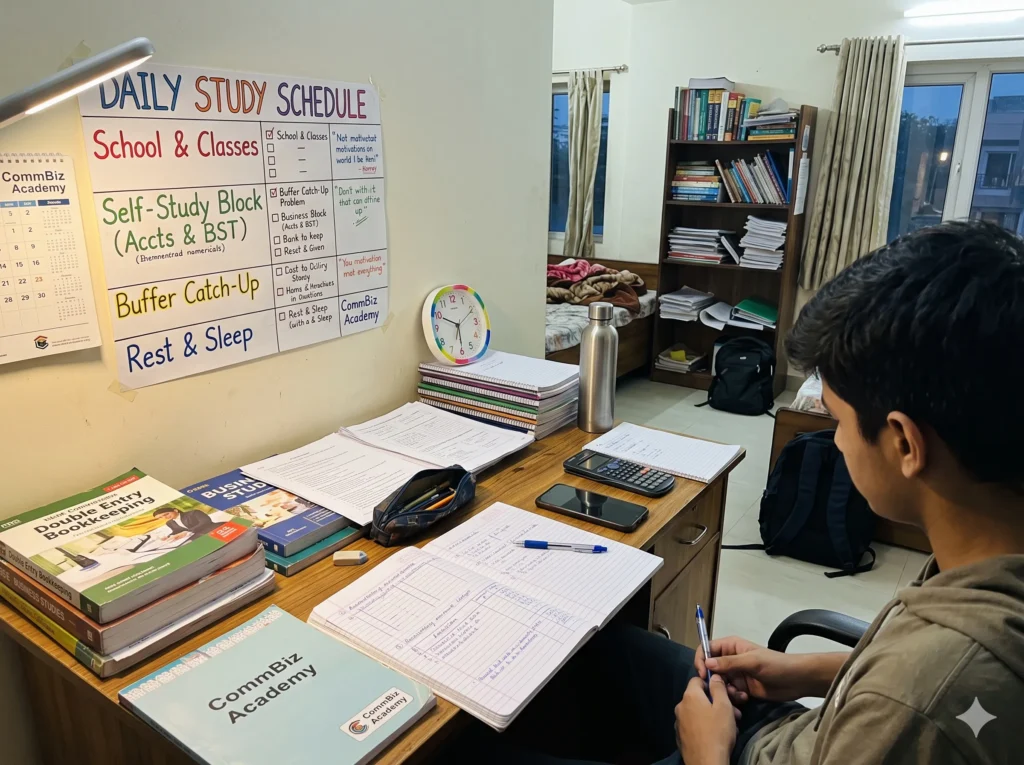
1. Stop Scheduling Hours—Start Scheduling Tasks
The biggest mistake students make is allocating rigid hours (e.g., “Study Accountancy from 6:00 PM to 8:00 PM”). If school runs late or a family errand pops up, your entire evening schedule collapses, leading to stress and frustration.
Instead, shift to a task-based system:
- Define Mini-Goals: Rather than writing “Study Accountancy,” write “Solve 3 Partnership Revaluation problems and review 2 journal entries”.
- Set Daily Priorities: Choose 2 or 3 non-negotiable core tasks for the day. Completing specific, actionable tasks gives you a sense of achievement and maintains daily momentum.
2. Balance Your Daily Routine: The 3-Block System
To avoid burnout and ensure you have time for rest, divide your day into three clear operational blocks:
[ Block 1: School & Classes ] ➔ [ Block 2: Focused Self-Study ] ➔ [ Block 3: Rest & Recharge ]
1. Fixed Time Block (School & Classes)
- What it includes: School hours, coaching classes, or live Zoom sessions.
- Strategy: Treat school hours with high active attention. Understanding a concept during class saves hours of struggle during home self-study.
2. High-Energy Self-Study Block (2 to 3 Hours)
- What it includes: Independent problem-solving, active recall, and note-making.
- Strategy: Schedule this block during your personal peak energy hours (either immediately after school or early evening). Protect this time from all distractions.
3. Non-Negotiable Rest & Recharge Block
- What it includes: Physical exercise, hobbies, family time, and 7–8 hours of sound sleep.
- Strategy: Rest is not “wasted time”—it is essential for memory consolidation and preventing study fatigue.
3. Use Short Sprints Instead of Marathon Sessions
Sitting at a desk for 4 hours straight leads to passive reading and frequent calculation mistakes. Instead, break your self-study into focused intervals using proven methods like the Pomodoro Technique:
- Study for 25 to 45 minutes with 100% focus (phone kept in another room or on silent).
- Take a short 5-minute break to stretch, drink water, or rest your eyes.
- After completing 3 or 4 study sprints, reward yourself with a longer 20-to-30-minute break.
This structure keeps your mind sharp, especially when tackling intense numerical subjects like Accountancy.
4. Alternate Between High-Effort and Light Subjects
Studying two heavy theoretical subjects back-to-back can leave your brain feeling saturated. Keep your schedule varied and engaging by mixing different subject types throughout the day:
- Combine Numerical + Theory: Pair a high-focus calculation subject (like Accountancy ledger practice) with a theoretical concept (like Business Studies principles or Economics).
- Vary the Activity: If you spent 45 minutes solving complex numerical problems, follow it up with a lighter task like reviewing flashcards, organizing working notes, or making quick summary diagrams.
5. Build Buffer Time and Plan for Flexibility
Unplanned disruptions—such as unexpected school assignments, family events, or simply feeling tired—are a normal part of life. A rigid timetable fails because it leaves zero room for error.
- Include a Daily 30-Minute Buffer: Leave an empty 30-minute slot in your evening schedule. Use this time to catch up on incomplete tasks or conduct a quick 15-minute evening review.
- Keep Sundays as a Catch-Up & Revision Day: Do not schedule new topics for Sunday evening. Use this time to revise what you studied during the week and plan your targets for the upcoming week.
Summary Checklist for a Sustainable Schedule
- Focus on Consistency Over Intensity: Studying for 2 to 3 structured, focused hours every single day yields far better results than cramming for 10 hours once a week.
- Put Distractions Away: Keep your phone out of reach during self-study blocks to protect your concentration.
- Prioritize Sleep: Getting 7 to 8 hours of sleep ensures your brain retains concepts and performs efficiently during exams.
- Be Kind to Yourself: If you miss a target, don’t abandon the whole schedule. Adjust your tasks for the next day and keep moving forward.
Conclusion: Smart Consistency Beats Unrealistic Timetables
Securing top board exam marks isn’t about sacrificing sleep or spending every waking hour at a study desk. It is about building a sustainable, balanced daily habit that respects both your academic goals and your well-being. By creating a flexible schedule focused on small daily steps, you eliminate study stress, build unshakable confidence, and achieve real academic success.
For structured live classes, step-by-step video courses, downloadable PDF study materials, and interactive board preparation for Class 11 & 12 Commerce across CBSE, ICSE, ISC, and NIOS, visit www.commbizacademy.com.
Keywords:
Daily study scheduleHow to create a study timetableStudent study scheduleStudy timetable for Class 12Study timetable for ISC & CBSE